Keeping your dog Safe on the Trail
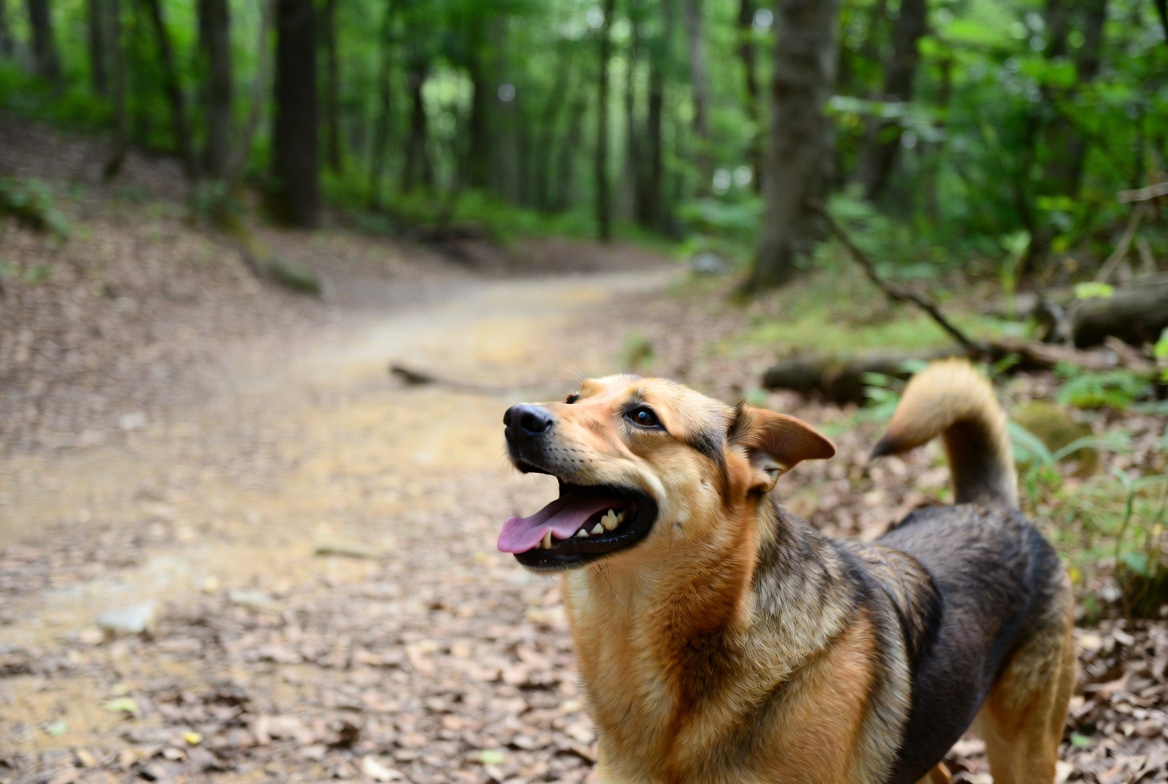
You know that magical moment after a long walk in the woods with your dog — they're happy, muddy, and completely exhausted in the best possible way? That moment right there is also when you need to do one very important thing before the cuddles begin: check for ticks.
Ticks are one of those things every dog owner knows about but not everyone takes seriously enough — until their dog gets one. And if you live in Pennsylvania, Texas, Florida, New York, California, Wisconsin, or really anywhere in between, ticks are not a "maybe" problem. They're a "when" problem.
Find a dog groomer near you
Browse 1,800+ vetted groomers across all 50 states. Filter by breed, services, and more.
Browse Groomers →This guide covers everything you need to know as a dog owner — what ticks look like, exactly where to find them on your dog, how to remove them safely at home, which states have the worst tick problems, and how to prevent them from ever becoming an issue in the first place. Consider this your tick survival handbook. 🐾
And while we're talking about keeping your dog healthy and clean — find a trusted groomer near you on DogBaths.com → Regular professional grooming is one of the best ways to catch ticks early.
🕷️ What Do Ticks Actually Look Like on a Dog?
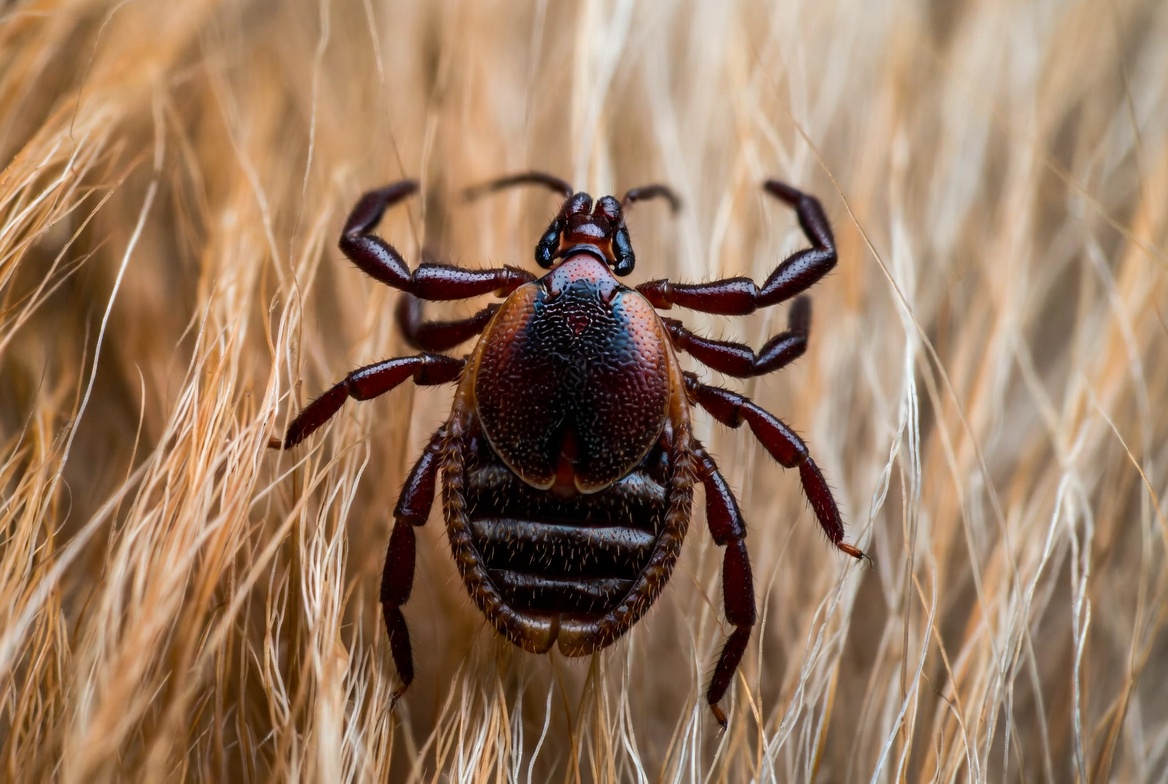
They often appear dark brown, black, or reddish-brown
If you've never seen a tick before, they're easy to mistake for a skin tag, a small scab, or even a mole — which is exactly why they go unnoticed so often.
Ticks are tiny arachnids (yes, they're related to spiders — you're welcome for that image) that range from about the size of a sesame seed to as large as a grape when fully engorged with blood. Before feeding, they're flat, oval, and brownish-grey. After feeding — which can take anywhere from a few hours to several days — they swell up dramatically and become darker.
Young ticks (larvae and nymphs) are even smaller — sometimes barely visible to the naked eye — which makes them especially sneaky. The nymph stage is actually when most Lyme disease transmission happens, because these tiny guys go undetected for so long.
Common tick species your dog might encounter in the US:
- Black-legged tick (deer tick) — Primary Lyme disease carrier, dominant in the Northeast and Midwest
- American dog tick — Common across the South and Central US, carries Rocky Mountain Spotted Fever
- Lone Star tick — Found heavily in Texas and the South, very aggressive, carries Ehrlichia
- Western black-legged tick — California's main tick concern, carries Lyme disease
- Brown dog tick — The only tick that can complete its entire life cycle indoors — yes, in your house
🗺️ Which States Have the Worst Tick Problems for Dogs?
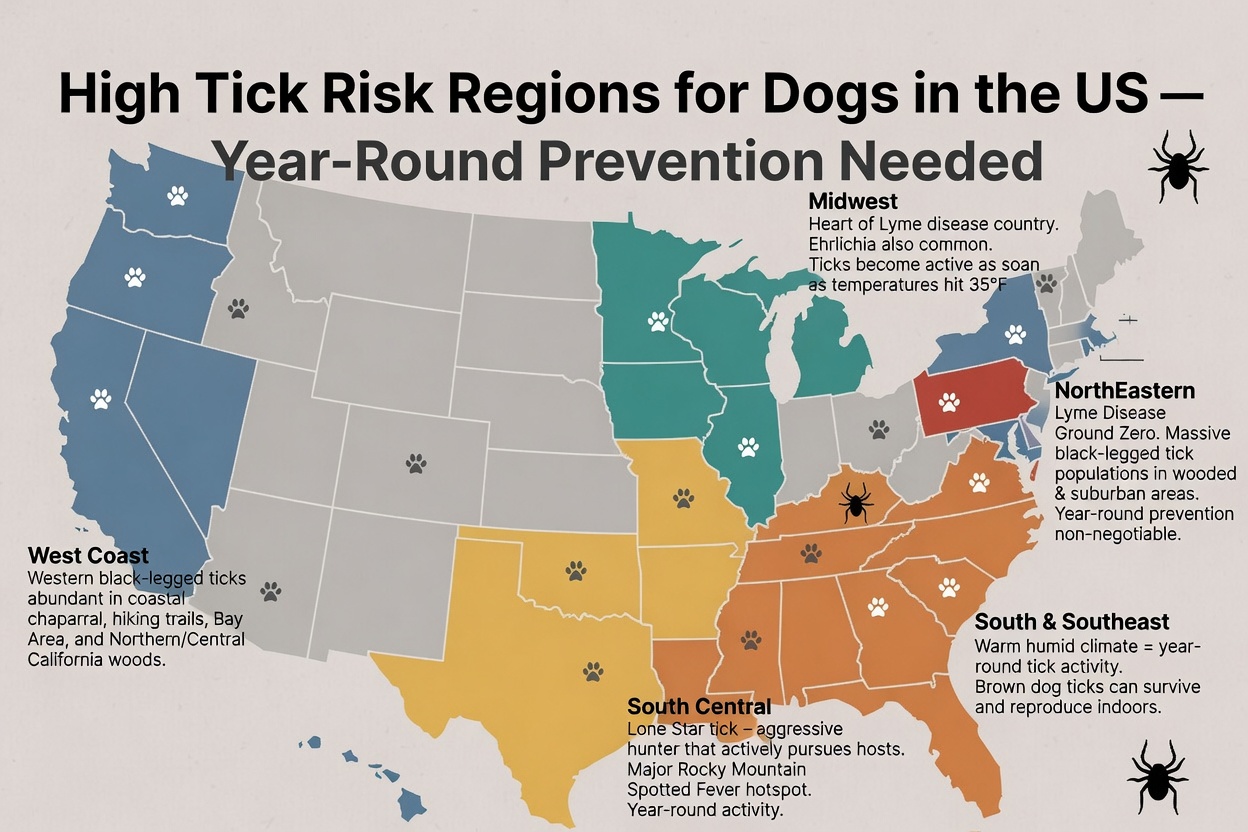
Map graphic of high-tick states
Here's the honest truth: ticks exist in all 50 states. But some states are significantly more dangerous than others, and if you live in one of these regions, tick prevention needs to be part of your regular dog care routine year-round — not just in summer.
Northeast — Pennsylvania, New York, New Jersey, Connecticut
The Northeast is ground zero for Lyme disease in the US. Pennsylvania and New York consistently rank as the highest-risk states for tick-borne illness, driven by massive black-legged tick populations in wooded and suburban areas. If your dog walks in any wooded area, park, or trail in these states, assume ticks are present. Year-round prevention is non-negotiable here.
South & Southeast — Florida, Georgia
Florida and Georgia's warm, humid climate means tick season never really ends. While Lyme disease is less common here, the American dog tick and brown dog tick thrive in these conditions. Brown dog ticks are particularly concerning because they can survive and reproduce indoors — making infestations possible even for dogs who don't spend much time outside.
South Central — Texas, Missouri
Texas is home to the Lone Star tick — an aggressive species that doesn't wait for a host to brush past. They actively pursue their targets. Texas and Missouri are major hotspots for Rocky Mountain Spotted Fever, which can be fatal to dogs if not treated quickly. The warm climate also supports year-round tick activity across most of the state.
Midwest — Wisconsin, Minnesota, Ohio
Wisconsin and Minnesota sit right in the heart of Lyme disease country. The dense forests and grasslands create perfect tick habitat, and the black-legged tick population here is significant. Ehrlichia — another tick-borne disease — is also frequently reported in Midwest dogs. Don't let the cold winters fool you; ticks in these states become active as soon as temperatures hit 35°F.
West Coast — California
California's coastal chaparral, hiking trails, and wilderness areas are gorgeous for dogs — and absolutely full of Western black-legged ticks. California actually tops some national tick activity lists, particularly in the Bay Area, coastal ranges, and wooded parks. If you hike with your dog anywhere in Northern or Central California, tick prevention is essential.
🔍 How to Check Your Dog for Ticks After Every Walk
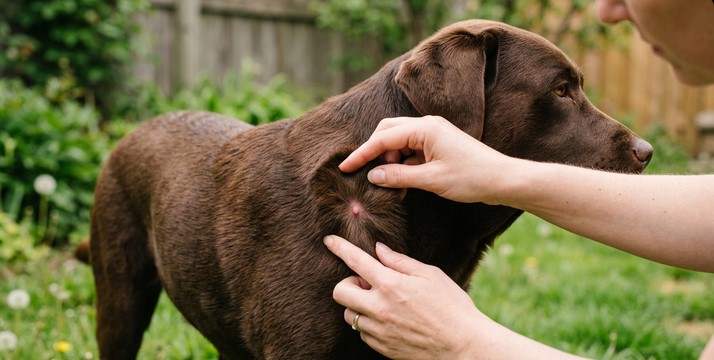
Checking your dog for ticks after a walk
Make this a ritual. Every single walk in any wooded, grassy, or brushy area — do a full tick check before your dog comes inside. It takes about two minutes and it genuinely matters.
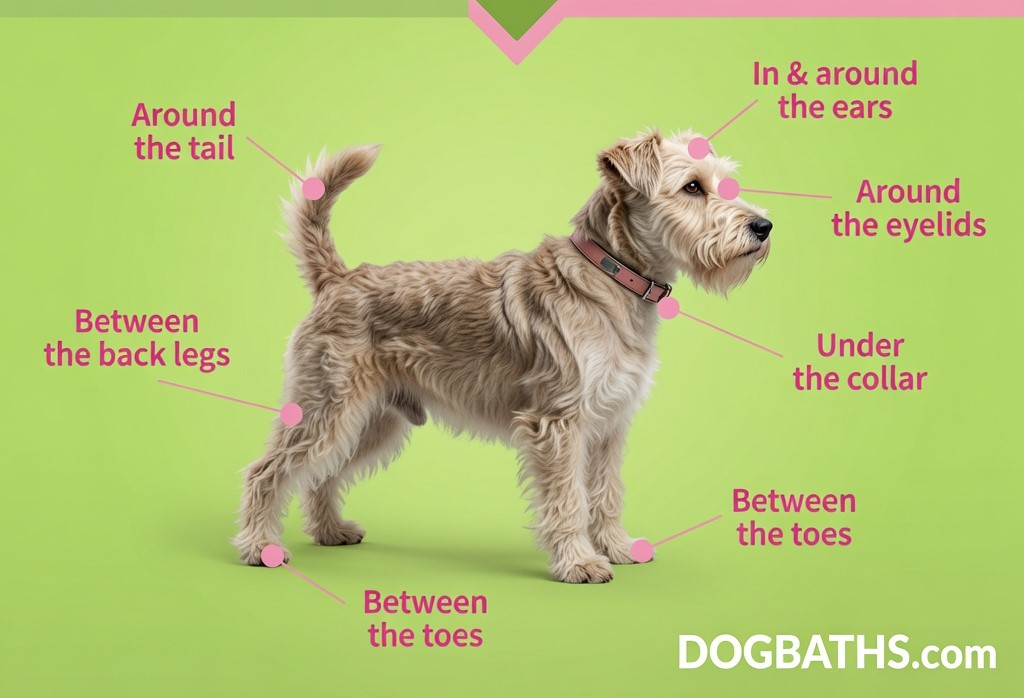
Ticks have favorite hiding spots on dogs — they go for warm, protected areas where fur is thicker and skin is softer. Here's your complete check list:
- 🐾 Between every toe and around all four paw pads — ticks love to hide here
- 👂 In and around both ears — including inside the ear flap
- 🦮 Under the collar — remove it and check underneath
- 🐕 Around the tail base and under the tail
- 💪 Under the "armpits" (where front legs meet body)
- 🦵 Groin area and inner thighs
- 👀 Around the eyelids and face
- 🐩 Along the spine and behind the neck
Run your fingers slowly through the coat, feeling for any small bumps. On dogs with thick or dark coats, use a fine-toothed comb and good lighting. Ticks feel like a small, firm seed attached to the skin — they don't move once they've latched on.
🛠️ How to Remove a Tick from Your Dog at Home
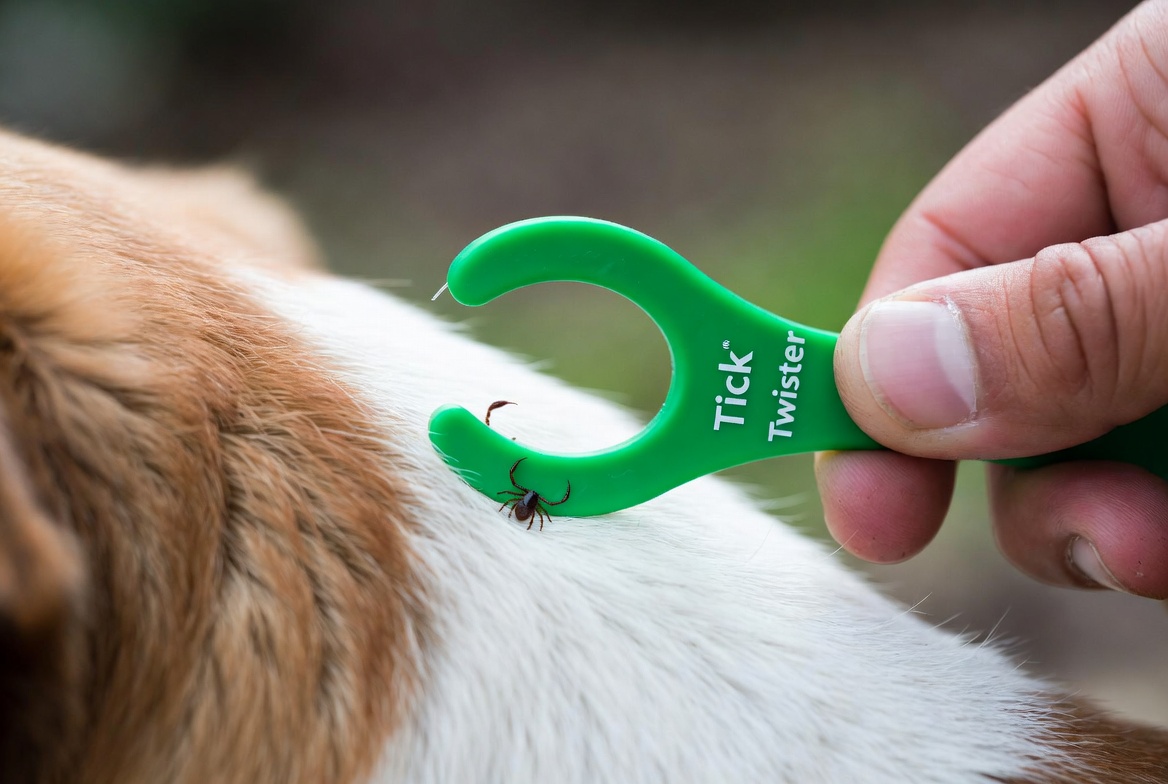
Tick Twister
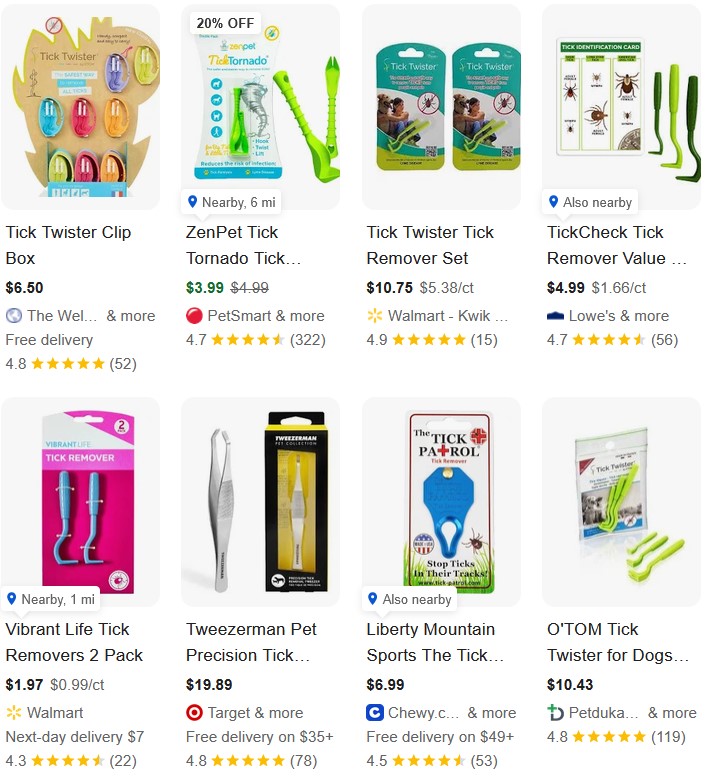
Tick Twister Shopping ideas
Found one? Take a breath. You can absolutely do this at home — and doing it correctly matters more than doing it fast.
What you'll need:
- Fine-tipped tweezers or a tick removal tool (a Tick Twister is fantastic and costs about $5)
- Latex gloves
- Rubbing alcohol
- A small jar or zip-lock bag
Step-by-step tick removal:
- Put on your gloves — never handle a tick with bare fingers
- Part the fur and get a clear view of the tick and where it's attached
- Grasp the tick as close to the skin as possible with your tweezers or tick tool — you want to grip the head, not the body
- Pull upward with slow, steady, even pressure — do NOT twist, jerk, or squeeze the body
- Once removed, drop the tick into a small jar of rubbing alcohol to kill it — or seal it in a zip-lock bag. Keep it for 30 days in case your dog develops symptoms and your vet wants to identify the species
- Clean the bite area with rubbing alcohol and wash your hands thoroughly
What NOT to do:
- ❌ Don't squeeze or crush the tick's body — this can push infected fluid back into your dog
- ❌ Don't use petroleum jelly, nail polish, or heat to "suffocate" the tick — these methods don't work and waste precious time
- ❌ Don't pull with your bare fingers — you can expose yourself to infection
- ❌ Don't panic if the mouthparts remain in the skin — remove what you can and monitor the area; the body will usually expel it naturally
After removal, the bite area may swell slightly — this is normal and should reduce within a week. If you see increasing redness, discharge, or your dog seems unwell in the weeks following a tick bite, call your vet and mention the bite.
🚨 Tick-Borne Diseases in Dogs — Know What to Watch For

The Vet Visit
Ticks themselves aren't the real danger — it's what they carry. Here are the main tick-borne diseases affecting dogs across the US and the symptoms to watch for:
Lyme Disease
The most well-known tick-borne illness in the US, caused by the bacteria Borrelia burgdorferi, transmitted by black-legged ticks. Most common in the Northeast, Midwest, and California. Symptoms often appear 2–5 months after a bite and include sudden lameness that shifts between legs, swollen joints, fever, fatigue, and loss of appetite. Treatable with antibiotics — but early diagnosis is key.
Rocky Mountain Spotted Fever (RMSF)
Despite the name, RMSF is most common in the South Central US — especially Texas, Missouri, and the Carolinas. It's one of the most dangerous tick-borne diseases in North America and can be fatal within days if untreated. Watch for sudden high fever, loss of appetite, joint pain, vomiting, and in severe cases, skin lesions. This is a genuine emergency — call your vet immediately if you suspect RMSF.
Ehrlichiosis
Transmitted by the Lone Star tick and brown dog tick, most common in the South and Midwest. Symptoms include fever, runny eyes and nose, swollen lymph nodes, and in chronic cases, bleeding disorders. Can be difficult to diagnose because symptoms vary widely.
Anaplasmosis
Often called "dog fever" — symptoms include high fever, lethargy, loss of appetite, and painful joints. Most common in the same regions as Lyme disease. Can occur alongside Lyme since both are transmitted by black-legged ticks.
Babesiosis
A serious infection that destroys red blood cells. Rare but potentially fatal. Signs include pale gums, yellowing skin, dark urine, weakness, and fever. Can take weeks to show symptoms after a bite — another reason to monitor your dog carefully after any tick encounter.
When to call your vet immediately: Any combination of fever, sudden lameness, lethargy, pale gums, loss of appetite, or vomiting in the weeks following a tick bite. Tell your vet about the tick — it helps them diagnose faster.
🛡️ How to Prevent Ticks on Your Dog — Year-Round
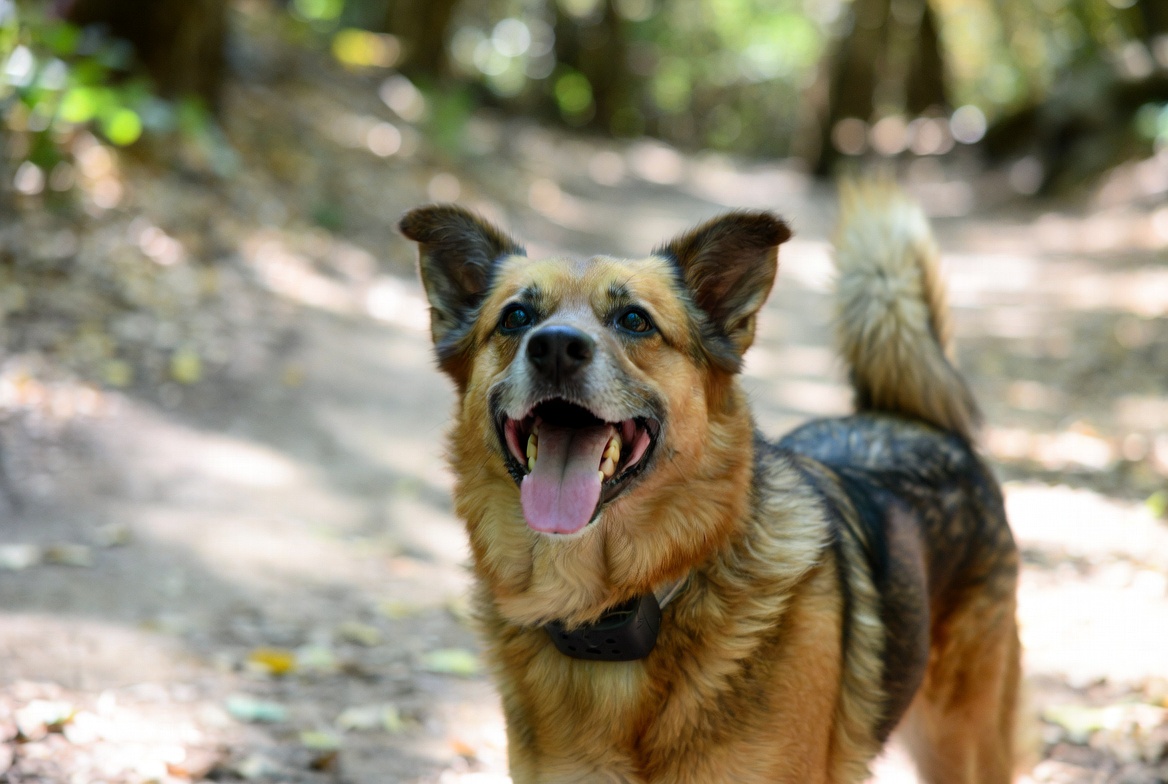
dog wearing tick prevention collar hiking outdoors
Here's the good news: tick prevention has never been more effective. You have real options that genuinely work, and combining a few of them gives your dog excellent protection.
Tick Prevention Products — Your First Line of Defense
- Oral tick prevention medications (Nexgard, Simparica, Bravecto) — prescribed by your vet, these kill ticks after they bite before disease transmission can occur. Highly effective, easy to administer as a chewable treat.
- Topical spot-on treatments — applied to the back of the neck monthly, repel and kill ticks on contact. Good option for dogs who won't take oral medications.
- Tick-repellent collars — Seresto collars provide 8 months of protection and are excellent for dogs who spend a lot of time outdoors. Particularly useful in high-risk states.
- Tick-repellent sprays — useful for hiking trips and outdoor adventures as an additional layer of protection.
Lifestyle Prevention
- Stick to the center of trails — ticks sit on the edges of tall grass waiting to latch on
- Avoid tall grass and dense brush during peak tick season (April–September, though ticks are active whenever temps are above 35°F)
- Do a full body check after every outdoor adventure — every single time
- Keep your yard grass short and cleared of leaf piles where ticks overwinter
The Lyme Disease Vaccine
If you live in a high-risk state — Pennsylvania, New York, New Jersey, Connecticut, Wisconsin, Minnesota, or California — ask your vet about the Lyme disease vaccine for dogs. It's a real thing, it works, and it adds a powerful layer of protection on top of your tick prevention routine.
Regular Professional Grooming — A Hidden Tick Defense
Here's one that surprises people: regular professional grooming appointments are genuinely one of the best ways to catch ticks early. A good groomer goes through your dog's entire coat systematically — including all the hidden spots owners miss. They see things you don't.
Regular brushing at home between appointments also removes loose fur that can hide ticks and gives you a chance to feel for anything unusual on the skin. Find a full-service grooming salon near you →
If your dog spends a lot of time outdoors and you want a thorough clean after hiking season, self-service dog wash stations are a great option for a thorough bath and brush-through between professional appointments. Find one near you on DogBaths.com →
🌿 Tick Season by State — When to Be Extra Vigilant
One of the biggest myths about ticks is that they're only a summer problem. In much of the US, ticks are active for most of the year — and in warmer states like Florida, Texas, and California, they never fully stop.
- Northeast (PA, NY, NJ, CT): Peak April–September, but active March–November. Black-legged ticks can be active in temperatures as low as 35°F.
- Southeast (FL, GA): Year-round tick activity. No true "off season."
- South Central (TX, MO): Peak March–October. Lone Star ticks are most aggressive May–July.
- Midwest (WI, MN, OH): Peak April–September. First warm days of spring bring immediate tick activity.
- West Coast (CA): Peak October–April during rainy season, but active year-round in coastal areas.
Frequently Asked Questions About Ticks on Dogs
How quickly can a tick make my dog sick?
It depends on the disease. Lyme disease typically requires a tick to be attached for 36–48 hours before transmission. Rocky Mountain Spotted Fever can transmit in as little as 2–20 hours. This is why doing a tick check immediately after walks — and removing ticks quickly — is so important.
Can ticks live in my house?
Yes — specifically the brown dog tick, which is the only tick species that can complete its full life cycle indoors. If your dog brings home brown dog ticks, they can establish in your home. If you find multiple ticks on your dog or in your house, call a pest control professional.
Should I save the tick after removing it?
Yes — put it in a sealed zip-lock bag or small jar with rubbing alcohol and keep it for 30 days. If your dog develops symptoms, your vet can send the tick for testing to identify the species and any pathogens it may carry.
My dog is on tick prevention and still got a tick — is that normal?
Yes, it's possible. Most tick prevention products don't repel ticks — they kill them after contact. A tick may attach and begin feeding before the product works. This is why tick checks after walks remain important even with prevention products. Ask your vet about whether a repellent-based product makes sense for your dog's lifestyle.
How do I find a groomer who does thorough tick checks?
Any professional groomer who does a full bath and brush will naturally check your dog's coat thoroughly. Browse verified groomers on DogBaths.com — search by your city and look for groomers with strong reviews mentioning attention to detail and gentle handling.
What states have the most tick problems for dogs?
Pennsylvania, New York, New Jersey, and Connecticut lead for Lyme disease risk. Texas and Missouri are highest risk for Rocky Mountain Spotted Fever. Florida and Georgia have year-round tick activity. Wisconsin and Minnesota rank highly for both Lyme disease and Ehrlichia. California's coastal regions have significant Western black-legged tick populations year-round.
Wherever you are — tick prevention, regular checks, and a great groomer are your dog's best protection. Stay vigilant out there, and enjoy every muddy, wonderful adventure with your pup. 🐾
Ready to find a groomer who'll help keep your dog clean, comfortable, and tick-free? Browse 1,800+ verified groomers across the US on DogBaths.com →